Impressively Realistic Movies About Space
In the world of Hollywood, it’s fair to say we see a lot of films about space that aren’t that realistic.
Explosions happening in space, spaceships battling like old wooden galleons, bombs dropping from spacecrafts through the gravity-void of space onto other spacecraft – we see a lot of Hollywood within sci-fi past and present.
However, there are quite a few films out there that strive for scientific accuracy over plot armor. Films that depict space in a way that matches our understanding of it.
Here are my top 5 realistic movies about space!
Apollo 13 (1995)
Apollo 13 is a docudrama film directed by Ron Howard that dramatizes the disastrous 1970 Apollo 13 lunar mission.
It stars Tom Hanks, Kevin Bacon and Bill Paxton as the astronauts en-route to the Moon for mankind’s third Moon landing mission when disaster strikes and the three spacemen have to embark on a perilous mission back to the Earth.
With an all-star cast, the film was a critical hit and ended up being nominated for 9 Oscars – winning one for Best Film Editing and Best Sound. Whilst being both a commercial and critical success, Apollo 13 also managed to portray the real-life events rather accurately.
Despite the fact there are a few inaccuracies giving way to artistic license throughout the film, such as the fact there was no argument between the astronauts Haise and Swigert (portrayed by Bill Paxton and Kevin Bacon, respectively), one of the film’s most iconic scenes uses almost verbatim dialogue taken from transcripts and recordings.
In the scene where the astronauts report to Ground Control they have a problem, the dialogue in this scene is almost word-for-word. The only thing that is slightly modified in this scene just so happens to be the film’s most iconic, stand-out moment.
In the film, when Tom Hanks says “Houston, we have a problem”, Swigert had actually said “Hey, we’ve got a problem here” whilst talking over Haise who had started off saying “Okay Houston”.
After this Ground Control had said “This is Houston, say again please” to which Jim Lovell had said “Houston we have a problem”.
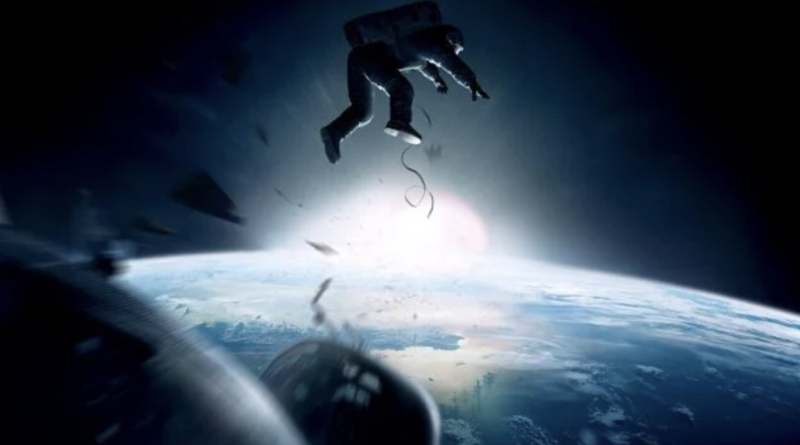
Gravity (2013)
Gravity was a huge commercial success and managed to scoop up 7 Oscars as well as 6 BAFTAs.
The movie stars Sandra Bullock and George Clooney as two astronauts trying to make their way to safety after their space shuttle is destroyed.
Gravity’s Writer, Producer and Director, Alfonso Cuarón, stated that Gravity wasn’t supposed to be taken as a documentary and that sometimes the scientific accuracy of the plot has been tampered to give way to artistic license.
However, the film has been praised overall for its realism and the way it adheres to the overall physical principles of being in space.
One NASA astronaut, Michael J. Massimino, even noted how a special type of wirecutter used in the film is the same he used during one of his own spacewalks.
It also earned the highest of praise from astronaut Buzz Aldrin, who described the film’s visual effects of space as “remarkable” and that he “was so extravagantly impressed by the portrayal of the reality of zero gravity.”
Despite the fact that some scientific inaccuracies occurred throughout the film, the way in which Gravity captures the essence of being within space and a zero-gravity environment earned it the praise of scientists and former astronauts alike.
The Martian (2015)
This 2015 sci-fi adaption of the book by the same name was directed by Ridley Scott and stars Matt Damon alongside an all-star cast as a lone astronaut besieged on the planet Mars, struggling to live on another planet whilst waiting to be rescued.
Set in the year 2035, Damon’s character Mark Watney is struck by debris and assumed to be dead as his crew aborts their manned mission to Mars amidst a catastrophic sandstorm.
Waking up, Watney finds himself alone in a battle for survival on the planet’s harsh surface.
During his writing of the source-material novel, Andy Weir had strived to present his science as correctly as possible, and had used a lot of reader feedback with the scientific community to ensure the final product was as accurate as possible.
NASA’s Director of the Planetary Science Division at the NASAScience Mission Directorate worked as a technical adviser for the film adaption, and said that the film was “reasonably realistic” although there were elements that were unrealistic or slightly changed.
Some things that were slightly unrealistic were the ways in which the NASA buildings depicted in the film were more stylish than their real-life, functional counterparts – although in general much of the astronomical science was rather accurate.
The Martian does portray a strong level of realism when considering some of the main plot points – such as the way in which Watney is able to produce water is an accurate process that is currently being used by NASA as part of a planned Martian Rover mission.
One of the film’s most iconic scenes has Watney growing potatoes on Mars when his rations are running out. In this scene, he uses the poop of the astronauts as a fertilizer for the Martian soil.
This moment is both entertaining and accurate, with many NASA scientists believing that, despite the toxicity of Mars’s soil, it could be possible to grow plants in it.